

The first time I used the The 4 Pleasures technique was when working with Elyssa Sfar of UBIK in a workshop we were running last year for lécole de Design Nantes Atlantique.
The seminar focused on the Aging Population, ‘Design to Improve Life’ and we used a number of methodology techniques, mostly from IDEO, but also included this one, developed by Patrick Jordan, because of it’s user-centred approach around the ‘pleasure’ derived from products.
The Four Pleasures is a framework developed to look at human experience and to understand people.
There are many reasons why we are attached to products or services, and this paper focuses on some of the reasons but it doesn’t mention “pleasure”. This is the basis of Patrick Jordan’s methodology outlined below.
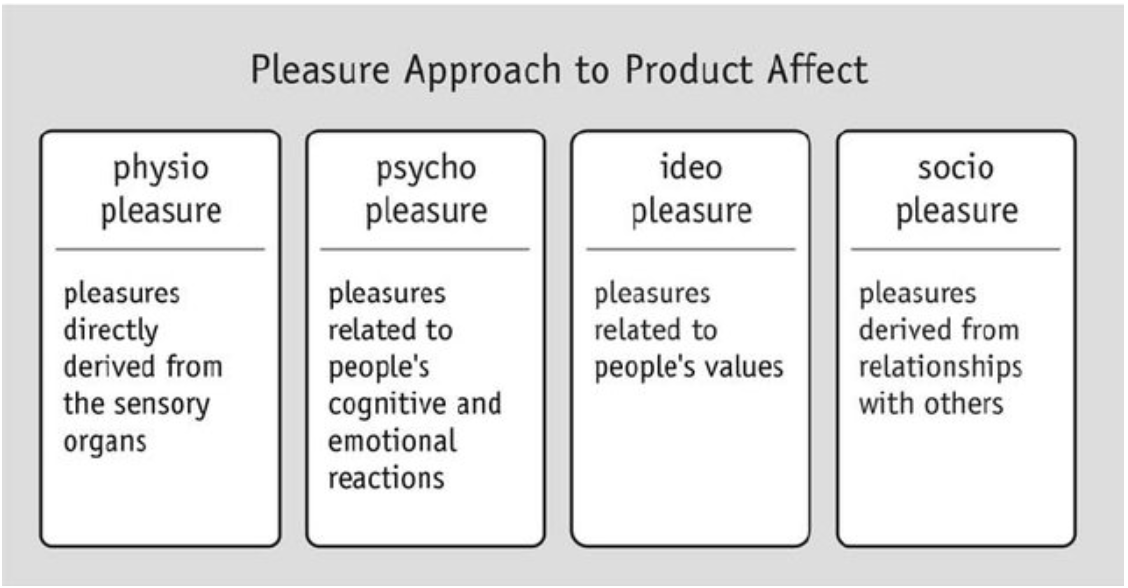
In order to connect with our customers and achieve market success, we need to provide them with positive, pleasurable experiences. These experiences can come into one of four categories – psychological, physical, social or ideological.
Physio-Pleasure: This is to do with the body – pleasures derived from the senses. In the context of products physio-pleasure would cover, for example, tactile and olfactory properties as well as ergonomic issues.
Socio-Pleasure: This is the enjoyment derived from relationships with others. Products and services may help to enhance or facilitate particular social situations and may confer social or cultural status on the user.
Psycho-Pleasure: This type of pleasure refers to people’s cognitive and emotional reactions, including their reactions to the products and services that they use.
Ideo-Pleasure: This concerns people’s values. It is important that the values embodied in products and services are consistent with the values of those for whom they have been designed.
“4 PLEASURES” METHODOLOGY
It was developed by Pat W Jordan, Doctor of Psychology and Marketing and Design Strategist. It consists of revealing the needs and motivations of users through 4 categories:
PHYSIOLOGICAL PLEASURE Pleasures derived from the senses. In the context of interior design, physiological pleasures are aimed at the senses of sight, touch, and even smell. These also have ergonomic consequences.
SOCIOLOGICAL PLEASURE Satisfaction derived from relationships with others. Products, environments or services can facilitate or enhance social situations, as well as provide a cultural or social status on the user.
PSYCHOLOGICAL PLEASURE This refers to people’s emotional reactions, including their reactions to the product/environment or the services it provides.
IDEOLOGICAL PLEASURE This applies to values. It is important that the values embodied in a product/environment or services are compatible with the values of the users.
So, the next time you design a product, really think about the pleasure you will give the user.
 DESIGN RESEARCH, MUSINGS AND INSPIRATIONS